
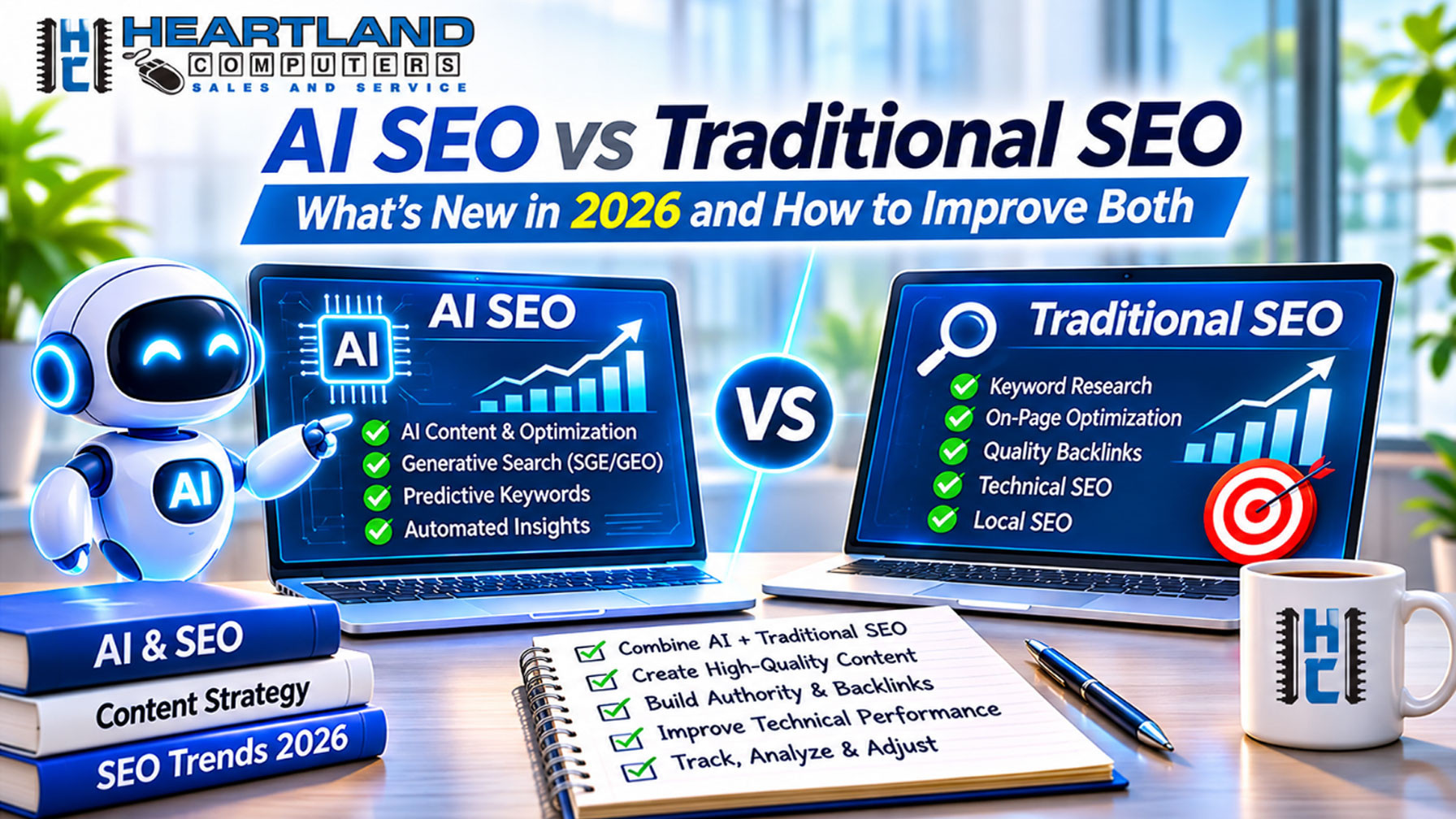

SEO still helps people find your business. What has changed is that a search may now end with an AI-generated answer, before someone visits your website. That makes visibility in the answer important, as well as your position in search results.
The good news: Google says its AI search features still rely on core Search ranking and quality systems. You do not need to throw out your SEO plan. You do need to make your content easier to find, trust, understand, and cite.
What’s new at a glance
| Traditional SEO | AI SEO and AI search | |
|---|---|---|
| Goal | Rank among the top ten blue links and earn a click | Be retrieved and cited in a generated answer, with or without a click |
| Competition | Pages competing for keywords | Pages, passages, and claims that help answer a question |
| Success measures | Rankings, impressions, clicks, and sessions | Visibility and citations, alongside clicks, calls, and leads |
| What helps | Useful content, relevant keywords, technical health, links, and local signals | Strong SEO foundations plus clear answers, first-hand detail, and trustworthy business information |
| What to ignore | Ranking shortcuts and thin pages | AI “hacks” such as special markup, tiny content chunks, and fake mentions |
Traditional search still matters. But clicks are less predictable when a search engine answers a question directly. Ahrefs reported that AI Overviews correlated with a 58% lower average click-through rate for the top-ranking page in its study. A separate SparkToro study estimated that about 68% of U.S. Google searches from January through April 2026 ended without a click. These studies use different methods and measure different things, so treat them as signals of change, not a forecast for every website.
There is some counterevidence: one report found organic click share reached a 15-month high in September 2026. A click may also come later, after someone reads an AI summary and decides to verify the answer or contact a business.
How AI search works
Google describes its AI search features as using retrieval-augmented generation, also called grounding. The system retrieves relevant pages from Google’s Search index, uses information from them to develop an answer, and can show links to sources.
It may also use query fan-out: running several related searches at once to explore parts of a question. A person asking how to fix a slow computer might also want to know about startup programs, storage space, malware, or hardware.
That means a page can be useful even if it does not match every word in the original query. Your content should answer real customer questions clearly, with practical details that add something beyond a general summary. Read Google’s guide to generative AI features in Search for its current guidance.

What stayed the same
Google says its AI search features are rooted in core Search ranking and quality systems. Helpful original content, crawlable pages, clear site structure, a good mobile experience, and accurate local business details still matter.
Google also confirms that PageRank and link analysis are part of its ranking systems. A trustworthy website is still built over time through useful pages, relevant links, and a good experience for the people who visit.
So keep improving traditional SEO. Add AI search visibility to your plan rather than replacing the basics.
What you need to do differently
- Give the direct answer first. Start important sections with a short, quotable response, then explain the details.
- Use question-led headings. Give each section one clear H2 question, a direct answer, and useful supporting information.
- Share first-hand specifics. Use your own process, examples, service details, and real customer questions. Do not publish generic summaries that anyone could write.
- Keep local details consistent. Check that your name, address, phone number, services, and hours match across your website, Google Business Profile, and directories.
- Answer pricing and comparison questions honestly. Provide real ranges when appropriate, and clearly explain what affects the final cost.
- Test AI answers yourself. Ask ChatGPT, Perplexity, Copilot, and Gemini questions your customers ask. Note whether your business appears and whether details are accurate.
- Track visibility separately from visits. Record citations, branded searches, calls, and leads as well as clicks. A person may read a summary and call days later without appearing as a search referral.
- Make useful pages worth visiting. Detailed troubleshooting, local guidance, helpful images, and video can give people a reason to click through.
Do not buy mentions or create near-duplicate pages for every search variation. Google warns that scaled pages made mainly to influence rankings or AI answers can violate its spam policies.
15 SEO ranking factors to improve
These fundamentals help traditional search and can support AI search visibility. No single factor guarantees a ranking.
-
Helpful, original content
What it is: Information that solves a real visitor need. Improve it: Add first-hand examples, clear answers, and details competitors cannot easily repeat. -
Title tag and H1
What they are: The page title shown in search and its main on-page heading. Improve them: Describe the page accurately and use a natural phrase customers would recognize. -
Headings
What they are: Labels that organize page sections. Improve them: Use descriptive headings that make the content easy to scan and answer one question at a time. -
Keyword relevance
What it is: How well a page matches the topic and intent behind a search. Improve it: Use the language customers use, but do not force repeated keywords. -
Experience, expertise, authoritativeness, and trust (E-E-A-T)
What it is: Signals that help people assess the experience and trustworthiness behind content. Improve it: Identify who provides the service, explain your process, and support claims with real evidence. -
Internal links and site architecture
What they are: Links and structure that help people and search engines navigate your site. Improve them: Link related pages together and make important services easy to reach. -
Backlinks and PageRank
What they are: Links from other sites that can help demonstrate relevance and authority. Improve them: Earn relevant links through good service, useful resources, and genuine community relationships. -
Crawlability and indexing
What it is: Whether search engines can access and understand your pages. Improve it: Check your robots.txt, XML sitemap, and canonical tags, then review indexing issues in Search Console. -
Core Web Vitals and page speed
What they are: Measures of loading, responsiveness, and visual stability. Improve them: Compress images, reduce unnecessary scripts, and fix slow or shifting page elements. -
Mobile and page experience
What it is: How easy your site is to use, especially on a phone. Improve it: Test menus, forms, buttons, and readability on mobile screens. -
HTTPS
What it is: Secure communication between your website and visitors. Improve it: Use HTTPS across your site and resolve mixed-content warnings. -
Image alt text
What it is: A written description of an image for accessibility and search understanding. Improve it: Describe the image’s purpose naturally, and do not stuff it with keywords. -
Structured data
What it is: Code that describes page information in a format search engines can read. Improve it: Use accurate structured data where it fits, and follow Google’s rules for rich results. -
Google Business Profile and local signals
What they are: Business information that helps local customers find and assess you. Improve them: Keep your profile complete and accurate, and make your services and locations clear on your site. -
Content freshness
What it is: Keeping time-sensitive information current. Improve it: Review pages when services, policies, hours, or processes change. Update for accuracy, not just to change a date.
For a local company, clear service pages matter too. Heartland Computer serves Omaha and Council Bluffs with website solutions, managed IT support, cybersecurity, and data backup. Our website design and development service follows a clear process: planning and sitemap, design and development, testing, and delivery.

Google AI SEO myths: what you do not need
Google’s guidance is practical. You do not need:
- An
llms.txtfile or special AI markup for Google Search. - To break content into tiny chunks for AI.
- To rewrite useful content just for AI systems.
- To arrange inauthentic brand mentions around the web.
- Structured data specifically for AI search. Structured data can still help with eligibility for traditional rich results.
Instead, make useful pages accessible to Google and genuinely helpful to visitors. Google also warns against scaled content abuse, such as producing many near-identical pages to chase small variations of the same query.
How to measure traditional and AI SEO
Use Search Console’s Generative AI performance report to review impressions and pages shown in Google’s generative AI features. Google’s announcement describes visibility reporting for those features. Pair it with the regular Search Console performance report, analytics, and your own lead records.
The report does not tell the whole story. Test real customer questions in different answer engines, note whether your business is cited, and verify that the information shown is correct. Ask new customers how they found you. That can help identify calls and visits that analytics do not connect to a search click.

The SEO tools that actually earn their keep in 2026
You do not need a big tool budget, but you do need the right few. Here is what is genuinely useful today, grouped by what it does.
Start with Google's own free tools
These are free, authoritative, and the source of truth about your own site.
- Google Search Console. The single most important tool you have. It shows indexing, queries, clicks, Core Web Vitals, manual actions, and now the Generative AI performance report.
- Google Analytics. Shows what visitors do after they arrive, and which channels produce leads.
- PageSpeed Insights. Real performance data, including Core Web Vitals.
- Rich Results Test. Confirms whether your structured data is valid.
- Google Business Profile. Not optional for a local business. Your hours, services, photos, and reviews all live here.
- Google Trends. Free way to see whether a topic is rising or fading before you write about it.
If you only have time for one thing, spend it in Search Console. Most SEO problems show up there first.
Keyword and competitor research
- Ahrefs and Semrush are the two heavyweights, and both are strong. Ahrefs is generally preferred for backlink data and site auditing, Semrush for built-in competitive and rank tracking reports. Either one covers what a small business needs.
- SE Ranking and Moz are the mid-priced alternatives. SE Ranking in particular is popular with agencies and small teams on a budget.
- Google Keyword Planner is free inside a Google Ads account and gives you real volume bands and trending data. It is slower to use than the paid tools, but the numbers come straight from Google.
Technical audits
- Screaming Frog SEO Spider. The standard for crawling a site and finding broken links, duplicate titles, missing meta descriptions, redirect chains, and crawl errors. The free version handles up to 500 URLs, which covers most small business sites.
- Sitebulb and the built-in audit tools in Ahrefs and Semrush are the paid alternatives, useful when you want scheduled recurring audits rather than manual crawls.
Content planning and writing
- Ahrefs and Semrush both include content gap tools that show which questions your competitors answer and you do not. This is often the fastest way to find your next ten blog topics.
- Clearscope, Surfer, and Frase are content optimization tools that compare your draft against the pages already ranking. Useful as a checklist, not as a formula. They reward keyword coverage, and they cannot tell you whether your point of view is worth reading.
AI visibility tools
This is the new category, and it is the biggest practical change in 2026. These tools ask AI platforms the questions your customers ask and report whether your brand is named, cited, and how often.
- Ahrefs Brand Radar starts at $50/month for 2,500 checks, which is one of the cheapest entry points available.
- Otterly AI starts around $29/month for 15 daily prompts, a reasonable small-business tier.
- SE Visible, Peec AI, Nightwatch, Rankscale, Scrunch, and Profound cover the range up to enterprise pricing. Nightwatch is worth noting if you already track traditional rankings and want AI visibility in the same place.
One genuinely useful finding from Ahrefs' 2026 research: AI answer positions are unstable. When a tool appeared on consecutive days, it kept the same position only 36% of the time. But the brands AI chose to recommend were very consistent, appearing again the next day 98% of the time. So do not obsess over position. Track mention rate (how often you appear at all), share of voice against competitors, and trend over four weeks. Those numbers actually tell you something.
Free tools worth bookmarking
- Ahrefs Free tools include an AI Visibility Checker, Keyword Generator, Backlink Checker, and AI Overviews Tracker at no cost. Good for spot checks when you are not ready to subscribe.
- Bing Webmaster Tools is worth setting up even if almost all your traffic comes from Google. It offers its own indexing and site scan data for free.
How to choose without wasting money
Start with the free stack: Search Console, Analytics, PageSpeed Insights, Business Profile, and a free crawl. If you only add one paid tool, make it a keyword and competitor platform. Add an AI visibility tool once you are publishing consistently enough for the data to mean something, and start on the cheapest tier rather than the plan a sales page recommends. Finally, ignore any tool that claims access to secret internal Google metrics. Google itself warns that those claims are not real.
Fast wins checklist
- Make sure important pages can be crawled and indexed.
- Put a direct, useful answer near the top of each service page.
- Improve titles, headings, and internal links.
- Check mobile usability, speed, HTTPS, and image descriptions.
- Review your Google Business Profile and directory details.
- Add specific service information and real examples.
- Test how AI assistants answer your customers’ questions.
- Track calls and leads, not just website sessions.
- Set up Search Console and Business Profile first if they are not connected yet.
- Check your top ten pages with a free crawler for broken links and missing titles.
Need help with your website?
SEO can feel complicated, but your next steps can be simple. Heartland Computer is locally owned, with storefronts in Omaha and Council Bluffs, more than 20 years of local experience, 50,000+ devices repaired, 98% client satisfaction, and an A+ BBB rating.
We can help with website design and development, remote computer support, managed IT, cybersecurity, and data backup. Contact us for straightforward guidance tailored to your business.
Call 402-502-7040 or 712-256-8686, or get in touch with our team. We’re here to help you make your technology work better.












Join the conversation
Questions about this article? Ask below — our team reads every comment.