
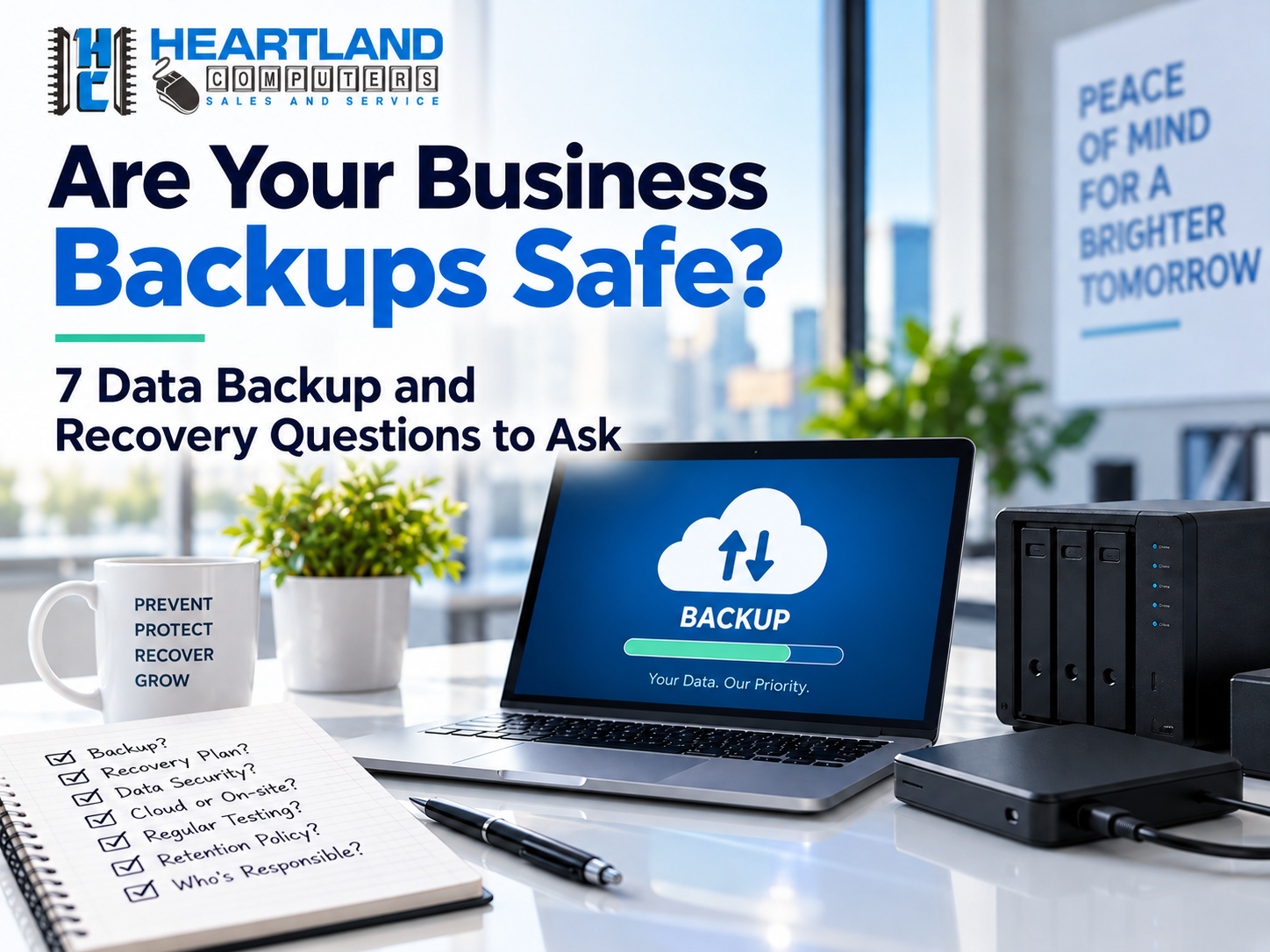
In short: Having a backup is not the same as having a recovery plan. A backup only counts as a real recovery plan if it
- covers all your critical data
- runs often enough to match how fast your data changes
- is encrypted and access-controlled
- includes an off-site or cloud copy
- is protected from ransomware
- can be restored within a time frame your business can tolerate
- has actually been tested.
If you can't answer all seven questions below with confidence, your backup and your recovery plan are not the same thing yet.
Every day, your organization relies on data: customer data, accounting files, email, staff documents, project files, website information, and system settings must all be accessible when needed.
A backup may exist yet still fail you. It could be incomplete, old, connected on the same network as your primary systems, or impossible to restore fast. A file-sync service may copy modifications without maintaining a clean version. A backup may exist, but it has not been examined to ensure that it works.
That's why businesses in Omaha, Council Bluffs, and the surrounding area should run through these seven questions regularly, not just after something goes wrong.
Backup vs. Recovery, in One Sentence Each
- Data backup is creating secure copies of your information before something goes wrong.
- Data recovery is restoring that information after data loss, corruption, hardware failure, or malware. A dependable plan needs both. It's not enough to save copies of your files, you need a clear, tested way to get those files back.
See Heartland Computer's Data Backup and Recovery services for a review of your current setup, with no unnecessary upselling.
Question 1: What Business Data Is Actually Backed Up?
Check: You have a written list of everything you backed up, including customer and client records, accounting/payroll/financial files, email, HR documents, shared folders and server data, website files and databases, business applications and configuration files, contact lists and calendars, project and design files, workstation rebuild settings, and data on laptops, external drives, and mobile devices.
Why it matters: Many firms believe everything is secure because a backup tool is installed on a single computer or server. Files on laptops or used by remote employees are frequently ignored totally. Protect the data that your organization cannot function without first and then review the rest.
Question 2: How Often Do Your Backups Run?
Check: Backups run automatically, failed jobs get reported to someone, older versions are retained, and you can restore a file from a specific past date.
Why it matters: If your company generates new files every day, a backup from the previous month will be ineffective. This is measured by your Recovery Point Objective (RPO), which is the amount of recent data you are willing to lose in the event of an incident. If missing a full day of work would be a severe issue, your timetable should run more frequently than once a day.
Question 3: Are Your Backups Encrypted?
Check: Data is encrypted while being transferred, saved, on external drives, in the cloud, and during remote recovery and backup administrator access is restricted to those who require it.
Why it matters: Backups frequently contain the same sensitive information as your live systems. If an unauthorized person gains access to a backup drive or cloud account, your data is exposed in the same way that your primary systems would be compromised. Encryption, limited credentials, multi-factor authentication, and access controls are all important combined.
Question 4: Are Copies Stored Off-Site or in the Cloud?
Check: At least one backup copy is kept away from your primary business location, either in a secure cloud backup, a separate location, encrypted off-site portable storage, or a managed backup environment.
Why it matters: A backup server close to your primary server will not aid in the event of a fire, theft, flood, or storm in the same location. The key is separation; if all copies are in the same place, on the same equipment, or on the same network, a single occurrence can wipe out everything at once.
Question 5: Are Your Backups Protected from Ransomware?
Check: When not in use, at least one backup copy is kept offline, safeguarded by immutability or retention controls, isolated from regular user accounts, saved with different credentials, and monitored for odd activity.
Why it matters: Ransomware can encrypt company files and seek harm associated backup systems too. A backup that is always connected and writable with the same accounts as your primary network is a danger. This is where the 3-2-1 rule comes in handy: three total copies of your data, two on various storage types, and one off-site. Some businesses go beyond 3-2-1-1-0, adding one offline/immutable copy and aiming for zero unresolved verification problems.
Question 6: How Quickly Can Your Business Restore Its Data?
Check: You know how quickly individual files, a full workstation, and a full server can be restored; recovery procedures are documented; and you know who oversees initiating recovery.
Why it matters: This is your Recovery Time Objective (RTO), which specifies how quickly a system must resume normal operation following an interruption. A tiny workplace can wait on some files but need fast access to accounting or client data. Restoring a single deleted file and rebuilding a whole system take vastly different amounts of time, equipment, and assistance; plan for each separately.
Question 7: Do You Perform Regular Recovery Tests?
Check: You've recently restored a file, folder, workstation, or system from backup, not merely validated that the backup software reported "success," and documented how long it took and what needed to be fixed.
Why it matters: A backup that has never been restored remains unverified. Software that reports a completed job does not ensure that all files are usable. Testing reveals missing data, out-of-date credentials, damaged files, or unrealistic recovery timelines before an actual issue occurs. Test again after making significant modifications to your network, servers, applications, or backup procedure.
Quick-Reference Table
|
Question |
Pass / Fail |
|
|
1 |
Is all critical business data actually backed up? |
☐ |
|
2 |
Do backups run often enough to match your RPO? |
☐ |
|
3 |
Are backups encrypted and access-controlled? |
☐ |
|
4 |
Is at least one copy stored off-site or in the cloud? |
☐ |
|
5 |
Is at least one copy protected from ransomware? |
☐ |
|
6 |
Do you know your Recovery Time Objective? |
☐ |
|
7 |
Has recovery actually been tested recently? |
☐ |
Scoring guide: 7 checked: your backup is working as an actual recovery plan. 5-6 passable, but a particular gap may cost you time or data. If you have four or fewer, you most certainly have a backup but no recovery plan; a review should be scheduled shortly.
Syncing Is Not the Same as Backing Up
File synchronization and backup can function together, but they are not the same. A sync service ensures that files are consistent across devices; if a file is altered, deleted, or encrypted, the changes may be copied to all linked devices. A real backup generates independent, point-in-time copies that include version history, retention, and a recovery mechanism apart from normal file access.
Ask your IT provider directly: "Can we restore an earlier clean version if a file has been removed or encrypted on all connected computers?" If the answer is uncertain, your company may depend on syncing rather than a comprehensive backup strategy.
Frequently Asked Questions
What's the difference between a backup and a recovery plan?
A backup is a copy of your data. A recovery plan is a tried-and-true technique for restoring data within a time window that your company can tolerate. A backup without a proven restore procedure, set RTO, and ransomware protection is not a complete recovery strategy.
What is the 3-2-1 backup rule?
Keep three copies of your data: two on different forms of storage and one off-site. Some businesses go beyond this to 3-2-1-1-0, adding one offline/immutable copy and a target of zero unresolved verification problems.
How often should a small business back up its data?
As frequently as your Recovery Point Objective requires, the amount of recent work you can afford to lose. Businesses that update records throughout the day require more frequent backups than those with fewer daily changes.
Can ransomware destroy backup files too?
Yes, if backups are always connected and readable under the same accounts as your primary network. This risk is considerably reduced by using an offline, immutable, or individually credentialed backup copy.
How do I know if my backup will actually work in an emergency?
Only by testing it. A "successful" backup report confirms the job ran, not that the files are usable to schedule real test restores and document the results.
Business Backup and Recovery Checklist (Full List)
☐ We have identified all critical business data.
☐ Our backups run automatically on a defined schedule.
☐ Backup failures generate an alert or follow-up.
☐ At least three copies of important data exist.
☐ Copies use at least two different storage types.
☐ At least one copy is stored off-site.
☐ Backups are encrypted during transfer and storage.
☐ Backup access uses separate, limited credentials.
☐ At least one copy is offline or protected from changes.
☐ Older versions of files are retained.
☐ We know our Recovery Point Objective.
☐ We know our Recovery Time Objective.
☐ Our recovery steps are written down.
☐ We test file and system restoration regularly.
☐ Someone is assigned responsibility for reviewing backup reports.
☐ Our team knows who to contact during a data loss event.
How Heartland Computer Can Help
Heartland Computer offers practical data backup and recovery support to small and medium-sized businesses in Omaha, Council Bluffs, and the surrounding area. Services include backup process review, critical data identification, off-site and cloud backup setup, ransomware protection, network and access review, healing testing, and remote or on-site support.
With over 20 years of local experience, we make recommendations based on your equipment, business operations, goals, and budget, which are clearly explained and without excessive upselling.
Don't Wait Until You Need the Backup
Your business's backup plan should instill confidence before a problem arises. Examine what's protected, how frequently copies are created, where they're stored, how they're secured, and whether recovery has been tried. If you're unsure whether your backups are safe, Contact Heartland Computer for a practical review and free consultation.
Sources & Further Reading
- CISA – Back Up Business Data - official guidance on the 3-2-1 backup rule and why regular, automatic, off-site backups protect against ransomware.
- CISA – #StopRansomware Guide - joint CISA/FBI/NSA/MS-ISAC guide covering immutable/offline backups, access separation, and ransomware recovery best practices.
- StopRansomware.gov - the U.S. government's central ransomware prevention and response resource hub (CISA, FBI, NSA, HHS, NIST, Secret Service).
- NIST – Recovery Time Objective (RTO), SP 800-34 Rev. 1 - official federal definition of RTO used in contingency planning.
- NIST – Recovery Point Objective (RPO), SP 800-34 Rev. 1 - official federal definition of RPO used in contingency planning.
Disclaimer: This checklist is provided for general informational purposes and does not guarantee data recovery in every scenario. Every business system, risks, and compliance needs are different. Contact Heartland Computer for a personalized backup and recovery assessment specific to your business.


















Join the conversation
Questions about this article? Ask below — our team reads every comment.